

Football and wellbeing for young people in southwest Sydney
Street Sports is a school-based football and wellbeing program, run by the Real8 Program Local Drug Action Team (LDAT) in Canterbury Bankstown, southwest Sydney, that builds the social connection and belonging that protect young people against alcohol and other drug (AOD) harm.
The LDAT is run by Street Industries, a grassroots organisation that uses sport, outreach, mentoring and social enterprise to reach young people. Street Industries runs several LDATs across Sydney, and the Real8 Program LDAT has completed six Community Action Plans (CAPs) since 2019.
Why the Real8 Program LDAT started Street Sports
What earlier projects showed
The LDAT’s earlier CAPs ran social and sporting activities for hundreds of young people, and doubled as consultation and data gathering. In 2022, Project Reimagine reached 191 young people through sport. It showed they wanted accessible, community-centred programs that build social connection and wellbeing.
Friday Night Football
In 2024, the Kicking off Change: Street Sports and LDAT Collaborative Project reached 303 young people through the Friday Night Football program in the Liverpool, Georges River and Canterbury Bankstown local government areas. It showed the value of positive role models and supportive networks in these areas.
A gap in access and connection
Both projects found that many young people in southwest Sydney had little access to local services and few chances to connect with their community, which are both risk factors for AOD harm. “We know there were different issues [in all of these regions] with access to social connections, no access to central services,” said Samey Minkara, CEO of Street Industries.
Reaching young people through sport
The gap was clearest for young men and women from culturally and linguistically diverse (CALD) backgrounds, and sport had already proven a good way to reach them.
How Street Sports works
Weekly football in two local high schools
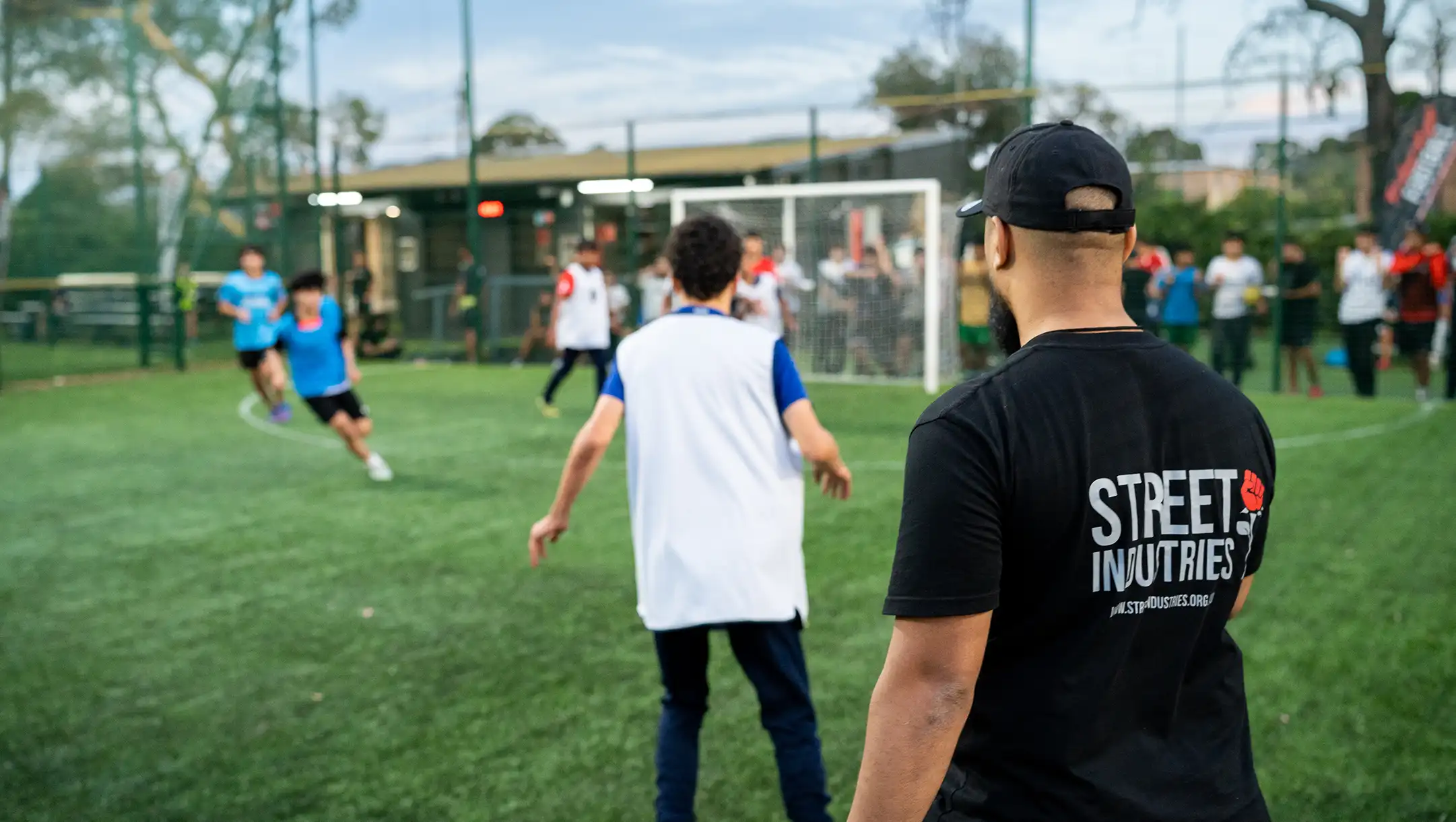
The LDAT’s 2025 CAP, Street Sports: Engaging Youth in Canterbury Bankstown, built on what the earlier projects showed. The LDAT partnered with two local high schools, a boys’ school and a girls’ school, and ran weekly football activities with wellbeing talks for a term at each school.
Building belonging through sport
For Samey, building a sense of belonging through positive social activities is the most important part of prevention. “Everything we do within the community, it all stems from that focus on social connection, to address risks and issues young people are facing,” he said. “The activities we focused on improve social connection.”

We gravitated towards football, because we knew there was a power in sport in bringing young people together, from different cultural backgrounds. Samey Minkara
Team-building drills and wellbeing talks
Football is an easy entry point that gets young people interested and involved. Soccer-based team-building drills help participants connect with each other. Each week, positive role models, including student support officers, football coaches and other wellbeing staff, gave talks on healthy decision-making and resilience. The Creating social connection, belonging and purpose toolkit guided the project design.
Results and advice from the Real8 Program LDAT
Results in 2025
The LDAT ran 17 Street Sports sessions in 2025, one more than planned. At the boys’ school, 60 Year 7 students took part, and 20 students from Years 7 to 10 took part at the girls’ school.
What students said
Evaluation showed the program built protective factors against AOD harm. After the program, 85% of boys and 78% of girls said they felt more connected with their classmates, beating the target of 70%, and 83% of girls said they had learnt more about looking after their health and wellbeing.
Advice for other LDATs
Samey’s advice to other LDATs comes down to one thing: keep it local. LDAT activities should be by locals, for locals, and based on up-to-date data from the area. “Our LDAT has been very effective because of its place-based approach to prevention,” he said.
Last reviewed: 8 November 2026