

What is a community of practice?
A community of practice (CoP) is a group of people who share a concern, a set of problems or a passion about a topic, and who deepen their knowledge and expertise by interacting on an ongoing basis.¹ Members improve their practice by meeting regularly, sharing experience and learning from each other.
How a community of practice works
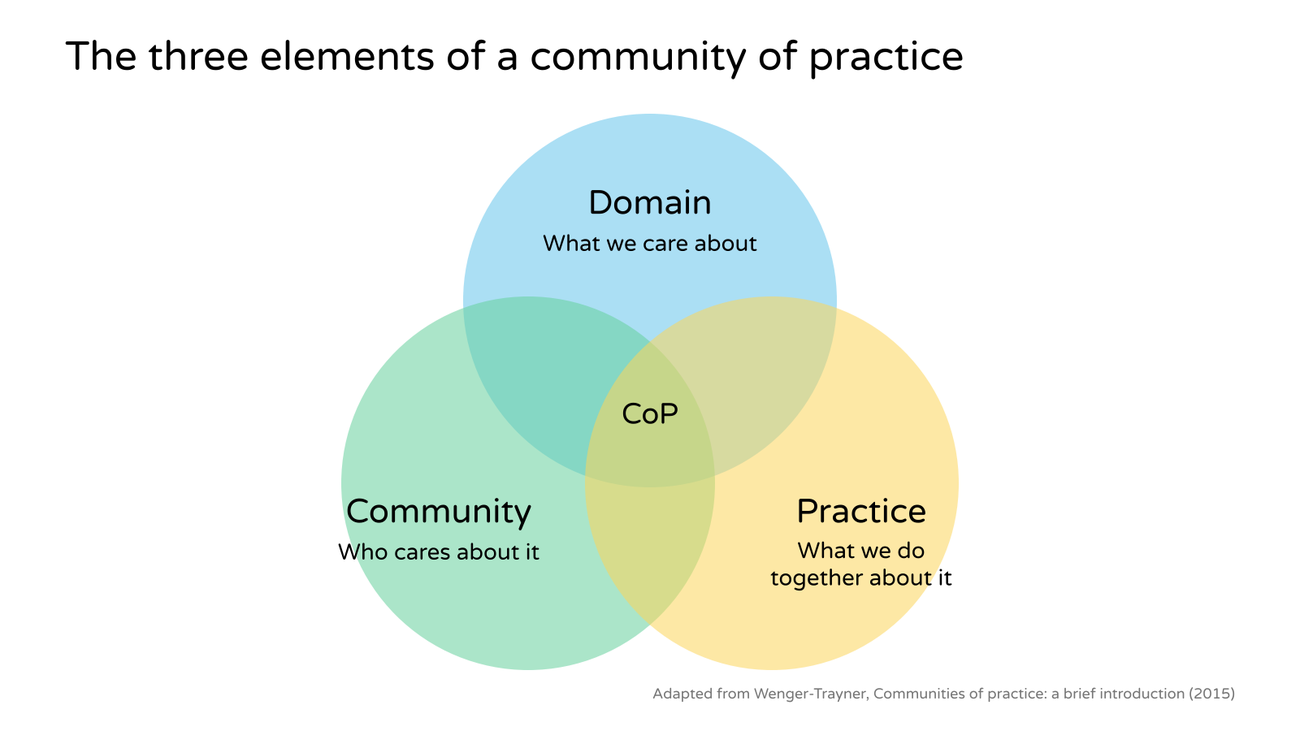
The three elements of a community of practice
Every community of practice has:
- a shared domain: the topic or area of interest that brings members together
- a community: members who interact, help each other and share information
- a shared practice: the experience, tools and ways of working that members build together.
Ways communities of practice meet
Communities of practice can meet in person or online. Formats include meetings, meetups, webinars, and conversations on Slack, Microsoft Teams or email.
The lifecycle of a community of practice
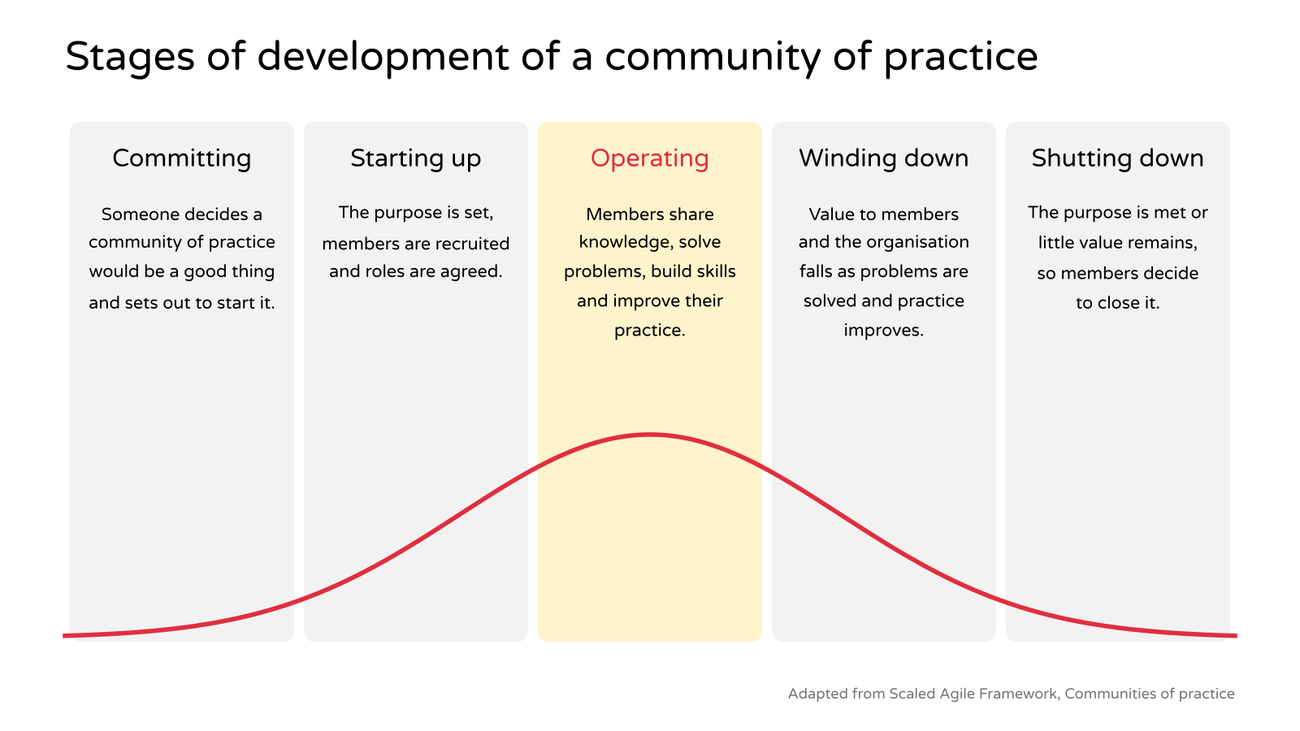
Communities of practice have a natural lifecycle. They begin with a new idea and end when the group has reached its objectives or the community no longer provides value.² Each topic a community takes on tends to follow a similar path of development.
Levels of participation
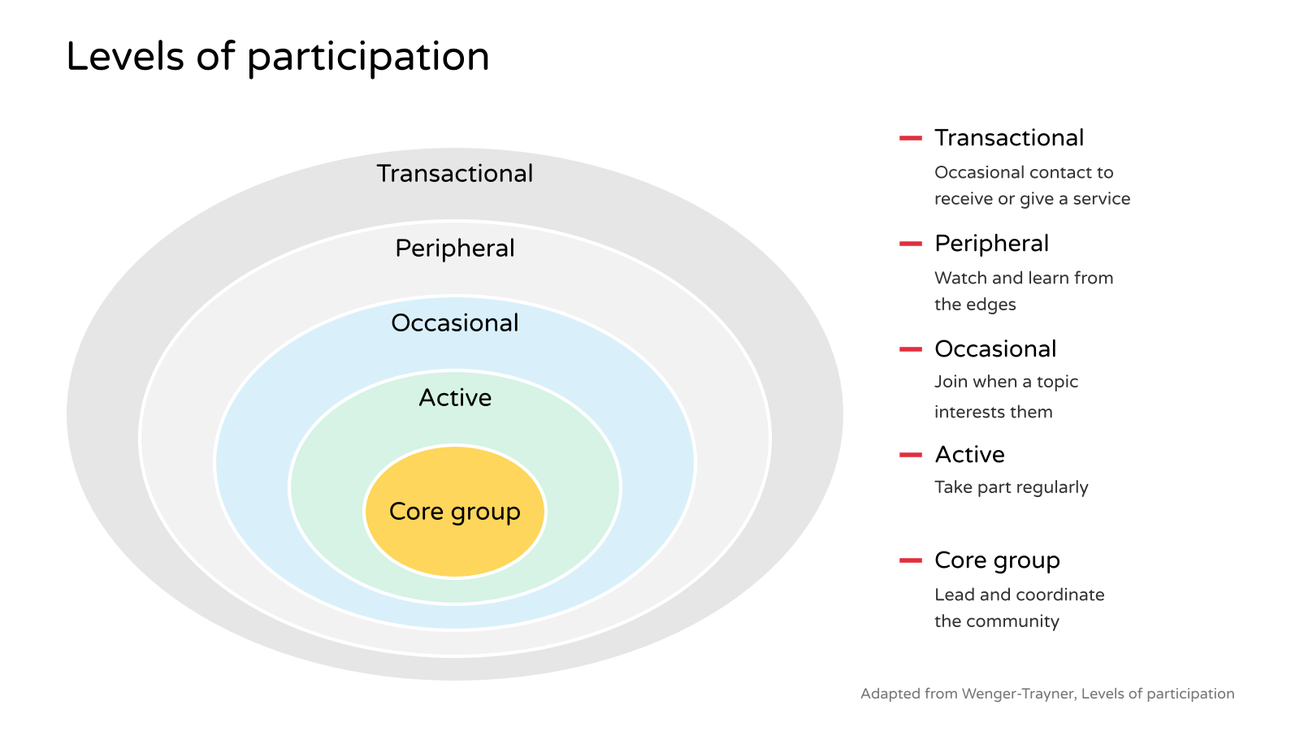
Members take part at different levels, from core members who lead the community to people who join occasionally, and they can move between levels as their needs and interests change.⁴
Guiding principles
Communities of practice work best when they are:³
- voluntary and community led
- self-driven
- responsive to members’ needs as they change
- focused on the information needs of members
- delivering value for members
- flexible, with different levels of participation
- run with a regular rhythm of formal and informal activities
- open to both internal and external voices.
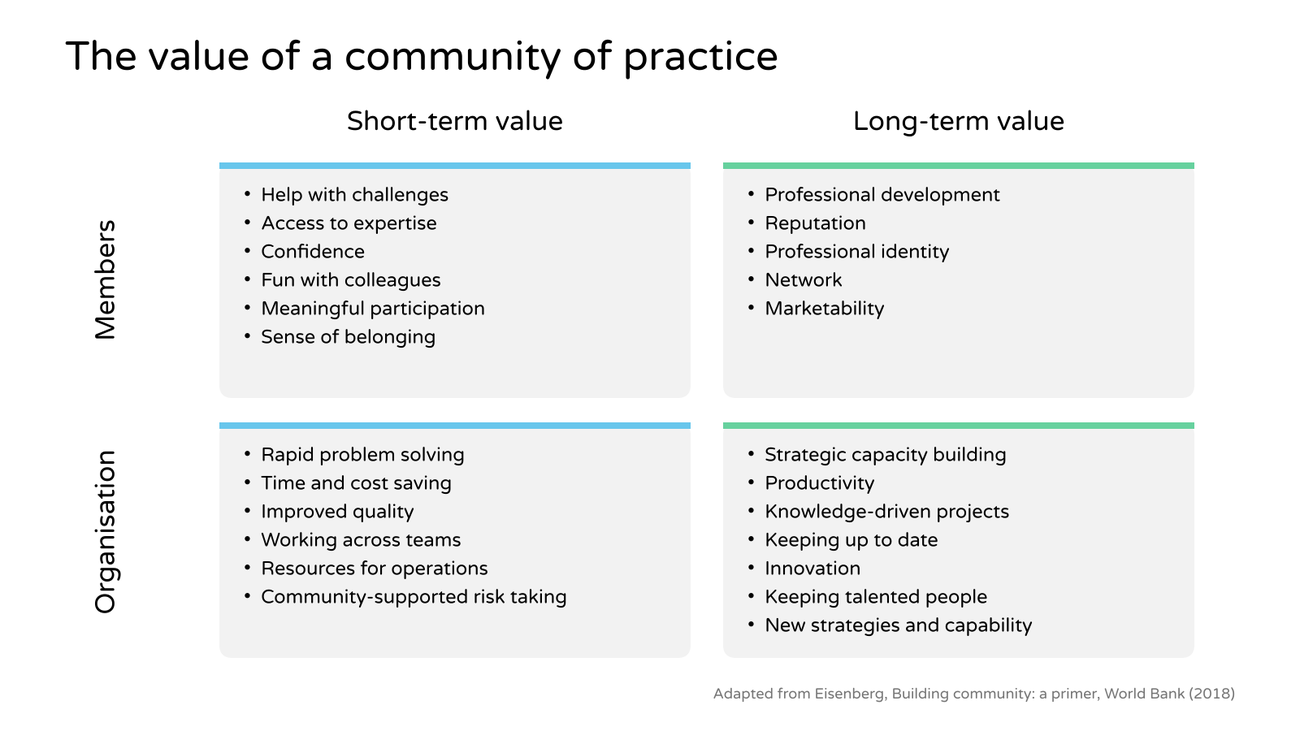
The value of a community of practice
Benefits for members
A community of practice helps members:
- stay connected with like-minded colleagues and peers
- share their experience and learn from others
- collaborate to achieve common outcomes
- learn faster
- build on existing knowledge and good practice
- innovate and create new ideas.
As communities of practice generate knowledge, they also renew themselves. In the words of one well-known description, they give you “not only the golden eggs but also the goose that lays them”.⁵
The LDAT community of practice
The ADF runs a community of practice for ADF staff and Local Drug Action Teams, to turn conversations into collaboration. LDATs can take part by logging in to the LDAT platform, or by contacting their Relationship Manager to find out more.
Last reviewed: 3 November 2026
References
- Wenger-Trayner E, Wenger-Trayner B. Communities of practice: a brief introduction. Wenger-Trayner; 2015. (PDF)
- Coakes E, Clarke S. An introduction to communities of practice. In: Encyclopedia of Knowledge Management. 2nd ed. IGI Global; 2010. p. 482–488.
- Wenger E, McDermott R, Snyder W. Seven principles for cultivating communities of practice. 2002.
- Wenger-Trayner E, Wenger-Trayner B. Levels of participation [slide]. Wenger-Trayner.
- Wenger E, Snyder W. Communities of practice: the organizational frontier. Harvard Business Review. 2000 Jan–Feb.
- Eisenberg R. Building community: a primer – 2018 update. Washington, DC: World Bank; 2018.
- Scaled Agile. Communities of practice. Scaled Agile Framework.