

AOD Lifecycle Planner
The AOD Lifecycle Planner is a free ADF guide that shows the alcohol and other drug (AOD) issues, risk factors, protective factors and influences for each age group, from 0 to 70+ years.
What’s in the AOD Lifecycle Planner?
Different people have different attitudes, behaviours, issues and risks, so an activity that focuses on a specific audience is more likely to be effective. The planner breaks this information down by age group, so you can design activities that suit the people you want to reach.
For each age group, the planner sets out:
- issues: the key AOD issues for that age group, which change as people age. For example, drink driving is an issue for people aged 18–30 and 50–60
- risk factors: things that increase a person’s risk of AOD harm. For example, a program addressing academic failure is more likely to have an impact for 6 to 11-year-olds than for people aged 50–60
- protective factors: things that reduce the influence of risk factors, such as positive role models for 12 to 17-year-olds, or volunteering and recreational activities for people aged 50–60
- influences: the people who can have a positive effect on your audience, such as parents, peers and GPs.
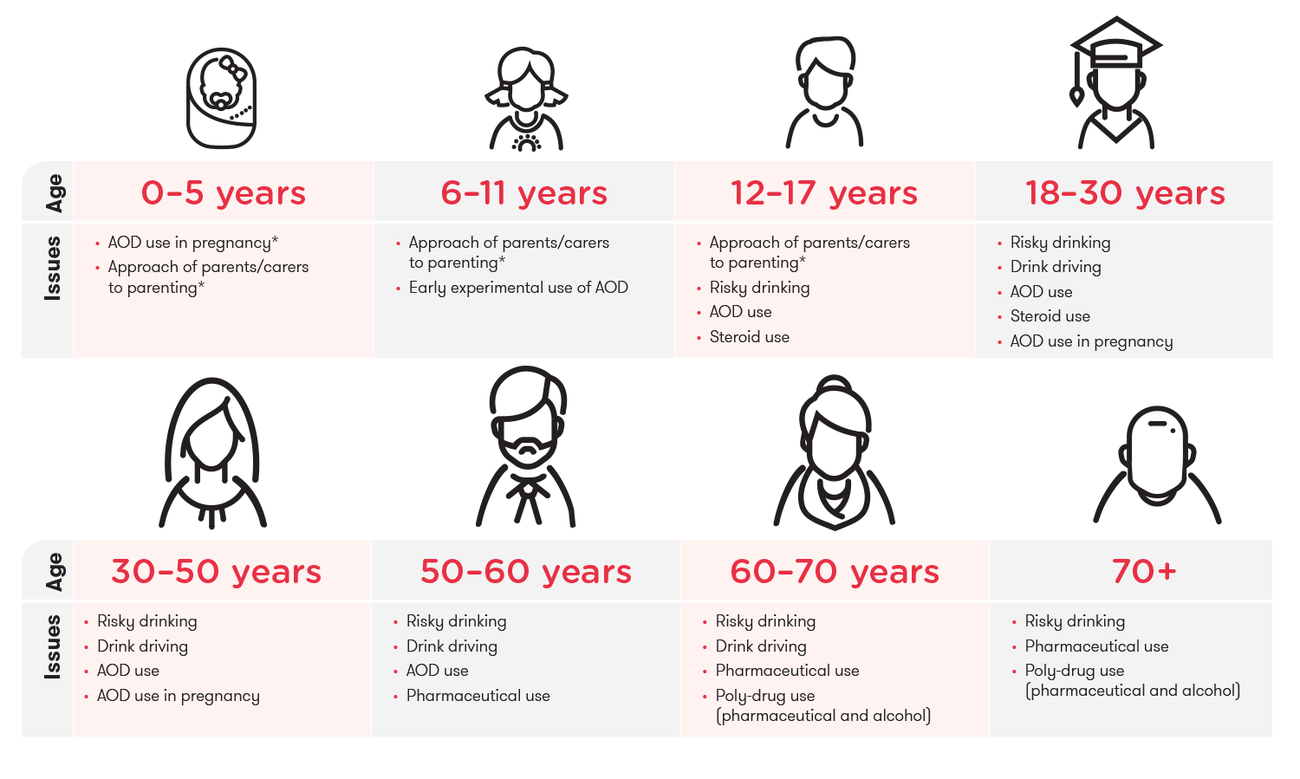
Key AOD issues by age group
- 0–5 years: AOD use in pregnancy, and parents’ and carers’ approach to parenting
- 6–11 years: parents’ and carers’ approach to parenting, and early experimental AOD use
- 12–17 years: parents’ and carers’ approach to parenting, risky drinking, AOD use and steroid use
- 18–30 years: risky drinking, drink driving, AOD use, steroid use and AOD use in pregnancy
- 30–50 years: risky drinking, drink driving, AOD use and AOD use in pregnancy
- 50–60 years: risky drinking, drink driving, AOD use and pharmaceutical use
- 60–70 years: risky drinking, drink driving, pharmaceutical use and poly-drug use (pharmaceutical and alcohol)
- 70+ years: risky drinking, pharmaceutical use and poly-drug use (pharmaceutical and alcohol).
How to use the AOD Lifecycle Planner
Use the planner when you start planning a project, and check back as it gets under way.
Find your audience’s life stage
Find the life stage of the people you plan to work with, then look at the issues, risk and protective factors, and influences for that group. For example, for people aged 30–50, the planner shows that:
- drink driving is an issue
- isolation, both geographic and social, is a risk factor
- taking part in social activities is a protective factor
- peers, GPs and carers are key influences.
Choose activities and toolkits
The planner suggests activities suited to each life stage. Each activity has an evidence-informed toolkit, with information and resources to help you plan and run it.
If you haven’t yet worked out which AOD issues matter most in your community, start with identify local AOD issues.
Download the AOD Lifecycle Planner
Download and print the planner to use in planning sessions with your partners.
Evidence behind the planner
The supporting evidence document lists the research the planner is based on.
Last reviewed: 30 October 2026